Baroxon® | Leading Boom Barrier Manufacturer

Parking Barrier Gate Philippines: How It Works
Release time:
2026-10-30
What Is a Parking Barrier Gate?
A parking barrier gate is a mechanical or motorized barrier installed at vehicle entry and exit points to control who may enter or leave a premises. It usually consists of a cabinet containing the motor and control mechanism, together with a long boom arm that rises to let an authorized vehicle pass and lowers to block the lane when needed. In the Philippines, it is used in condominiums, subdivisions, offices, shopping malls, hotels, schools, warehouses, industrial parks, and paid parking facilities.
Quick answer: A parking barrier gate is a motorized boom barrier that opens only for authorized vehicles through RFID, UHF, LPR/ANPR, QR code, remote or manual control, with safety sensors helping to prevent the arm from closing on a vehicle. Choose the model according to lane width, traffic volume, access method, and the safety requirements of the site.
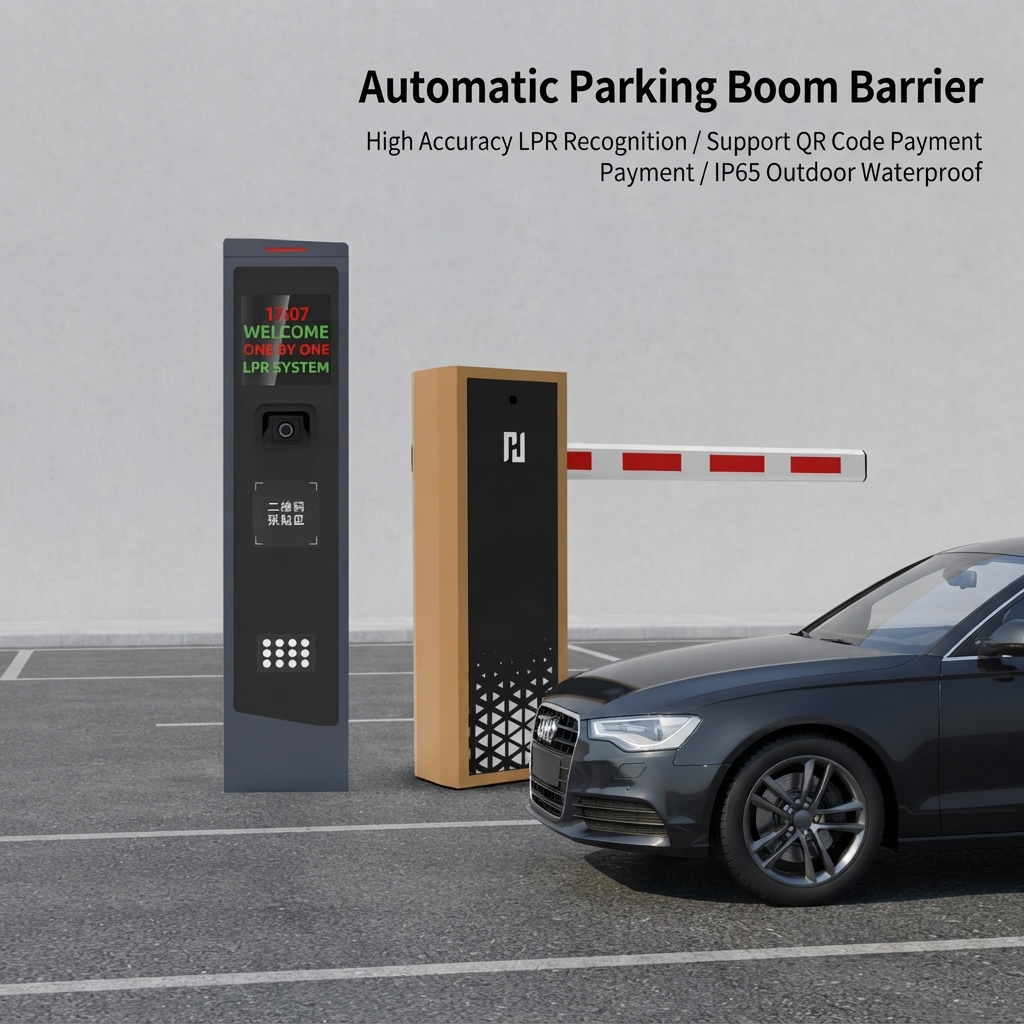
How Does a Parking Barrier Gate Work?
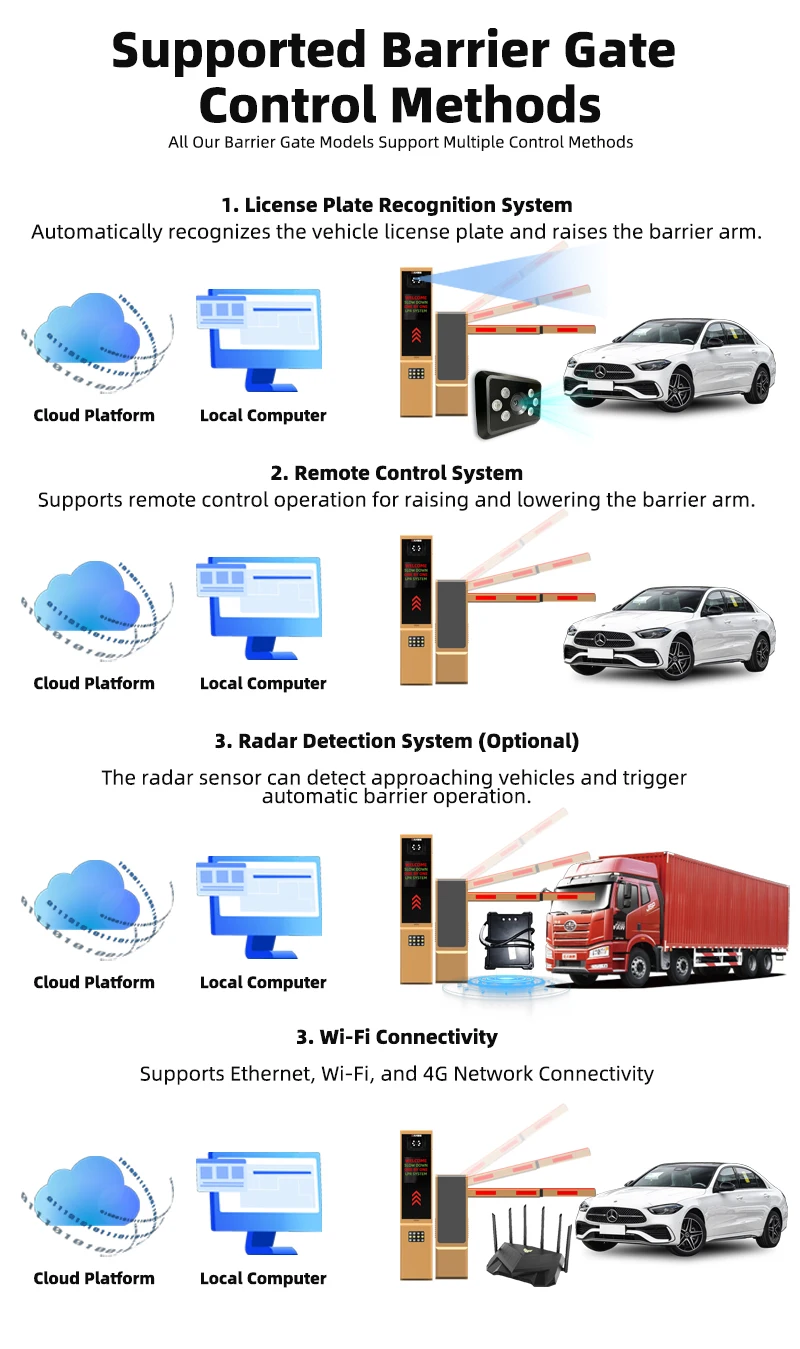
A parking barrier gate typically works through four parts: the barrier mechanism, access-control device, controller, and safety sensor. When a vehicle arrives, the access-control system first checks whether it is authorized. Once a valid signal comes from an RFID card, UHF tag, LPR/ANPR camera, QR code, remote control, or security operator, the controller sends the command to raise the boom arm. After the vehicle has passed and it is safe to close, the system lowers the arm again according to the installation configuration.
Step-by-Step: The Vehicle Entry Process
- Vehicle approach. The vehicle stops or slows down at the designated detection area before the barrier arm. There should be clear lane markings and enough distance so that the vehicle does not block the pedestrian walkway or the adjacent lane.
- Access verification. The system reads the credential or identifies the plate number. For RFID/UHF, a valid card or tag is required; for LPR/ANPR, the camera must read the plate number clearly and match it against the permitted list or the parking rules.
- Boom arm raises. Once verification passes, the controller sends a signal to the motorized barrier to raise the arm. The barrier may be integrated with parking management software to record the entry time, vehicle identity, or transaction, depending on the system configuration.
- Passage and safety monitoring. The vehicle drives through the lane while the loop detector, radar, photoelectric sensor, or other compatible safety device monitors its presence. The correct sensor configuration helps prevent the arm from lowering early while a vehicle is still underneath it.
- Closing and logging. Once the detection zone is clear and the safety logic permits closing, the arm returns to the closed position. If connected to parking software, the system may update the access record or parking status.
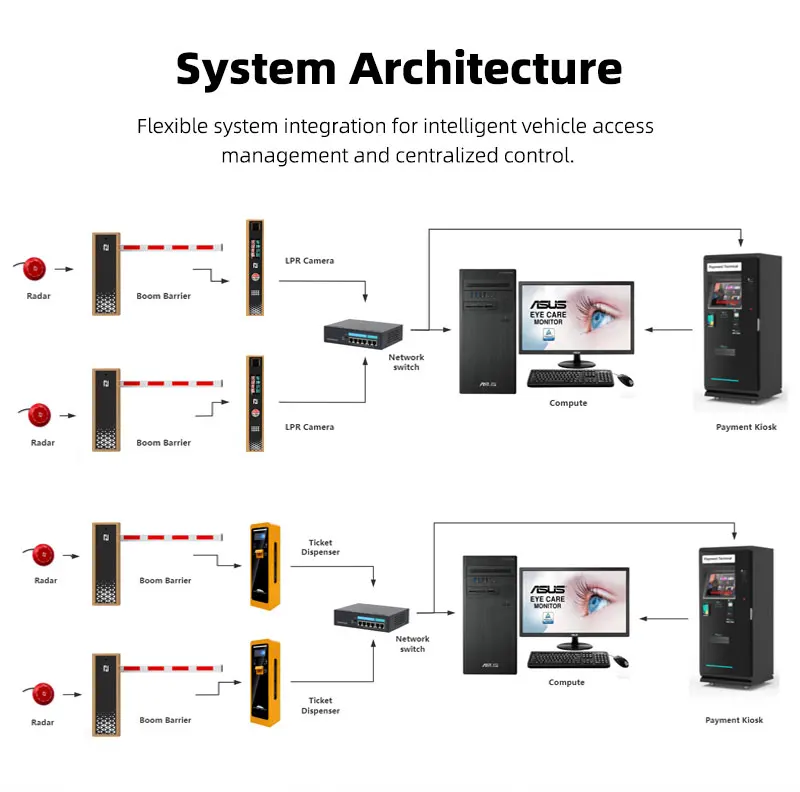
Key Components of a Parking Barrier System
- Barrier cabinet and motor: This houses the drive mechanism and control components that move the boom arm. Choose a model suited to the arm length, frequency of use, and traffic volume of the site.
- Boom arm: This may be a straight arm, folding arm, or fence-style arm depending on clearance, lane width, and site requirements. A folding arm can help at entrances with low ceilings, but compatibility and installation dimensions must be confirmed.
- Access-control reader or camera: This may use an RFID card reader, long-range UHF reader, LPR/ANPR camera, QR code reader, or manual control. Not every configuration is included in every model; confirm the interface and accessories before buying.
- Controller and software: This processes the access signal and may communicate with a parking management system, payment system, database, or remote monitoring platform where supported by the configuration.
- Safety devices: The loop detector, radar, photoelectric sensor, and anti-collision functions may be used depending on the model and installation. The safety logic should be designed and tested by a qualified installer for the actual site layout.
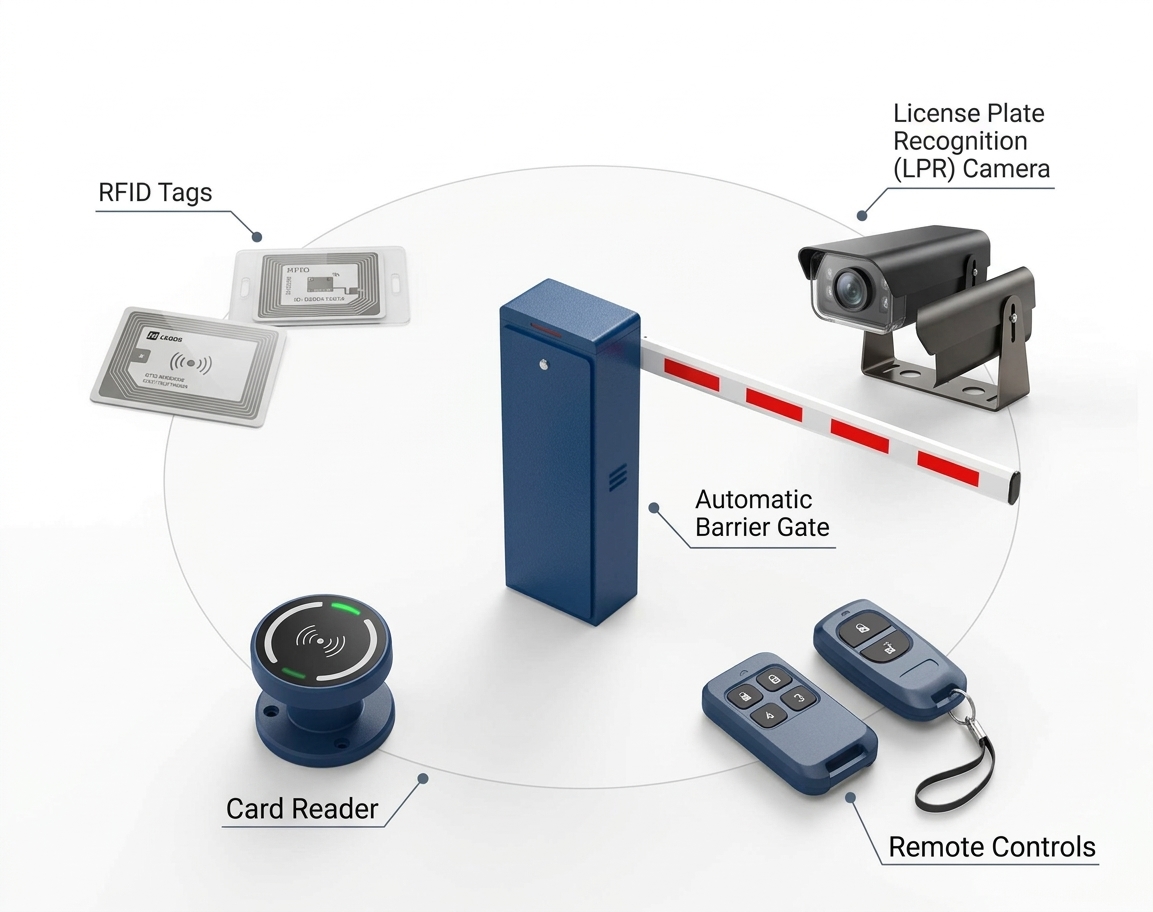
What Access Methods Can Be Used?
RFID Card and UHF Tag
An RFID card is practical for residents, employees, or regular users who can tap or present a credential at the reader. A UHF tag system, on the other hand, can read a compatible tag from a longer distance, depending on the reader, tag, mounting position, and lane conditions. It is worth evaluating for gated communities, corporate parking, and fleet access where registered vehicles pass through frequently.
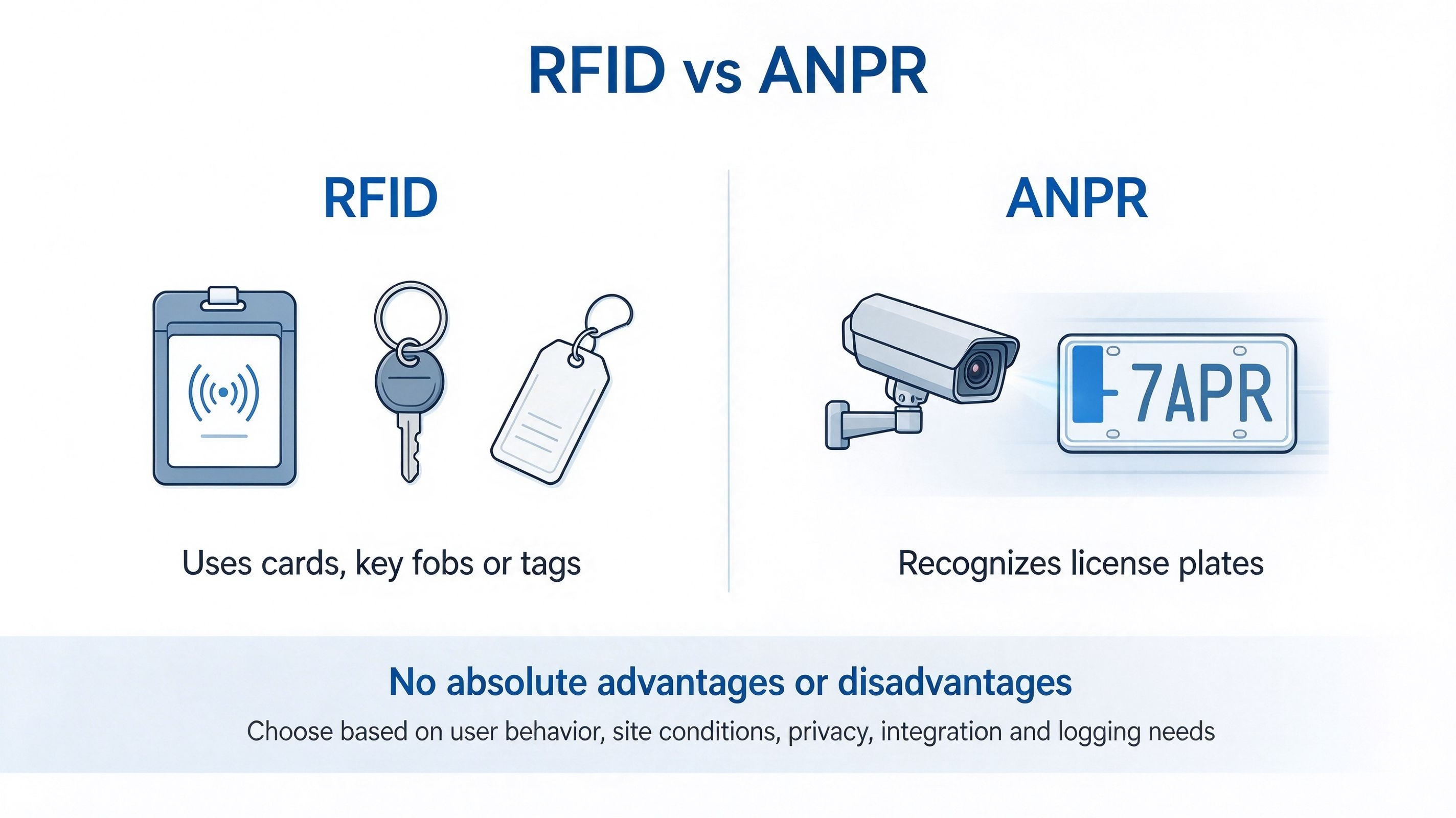
License Plate Recognition (LPR/ANPR)
An LPR/ANPR system uses a camera and recognition software to read the license plate of a vehicle. If the plate is registered and the access rule is met, the system can trigger the barrier to open without the driver having to tap a card. The correct camera angle, lighting, plate visibility, network reliability, and a process for unreadable plates all matter. LPR/ANPR is not a guarantee of perfect recognition in all conditions.
Remote Control, QR Code, and Manual Authorization
For some sites, a wireless remote, QR code, intercom, or security guard authorization may be used. The right choice depends on the number of vehicles, visitor management requirements, level of security, and whether an audit trail is needed. Confirm with the supplier which of these interfaces are native, optional, or require a third-party controller.
Where Are Parking Barrier Gates Used in the Philippines?
- Condominium and subdivision: To limit entry to residents, visitors, delivery vehicles, and service providers, and to help build access records.
- Office building and commercial parking: To separate employee parking, visitor access, and public parking, and to support parking validation or billing workflows where required.
- Shopping mall, hotel, and hospital: To manage peak-hour traffic, designated lanes, and vehicles with specific authorization. There should be a clear emergency access procedure.
- Warehouse, factory, and logistics hub: For control of trucks, delivery vans, contractors, and fleet vehicles. At such sites, consider duty cycle, arm length, visibility, and integration with guardhouse procedures.
- Tollway and public facility: To help regulate vehicle flow where the barrier system is part of a broader tolling or access-management setup. The actual configuration should be designed for the volume and operating requirements of the project.
How to Choose the Right Parking Barrier Gate
- Measure the entrance and choose the arm type. Determine the lane width, available clearance, ceiling height, and vehicle direction. Do not choose based on a product photo alone; ask for a dimension drawing and installation requirements.
- Define traffic volume and duty cycle. A small residential parking entrance may have different requirements from a mall, warehouse, or toll facility. Give the supplier the estimated number of vehicles per hour and the peak periods so that the operating speed and duty rating can be matched.
- Choose the access method. Decide whether RFID, UHF, LPR/ANPR, QR code, remote control, or a combination is needed. Consider how visitor access, temporary credentials, lost cards, and plate changes will be managed.
- Review safety and emergency operation. Ask which safety sensors and anti-collision features are compatible with the model. Also plan a manual release or backup procedure for a power failure or system fault.
- Confirm integration and after-sales support. If the barrier will connect to existing parking software, CCTV, a payment terminal, an intercom, or an access database, ask for interface details and a responsibility matrix. Also confirm warranty, spare parts, installation guidance, and remote technical support.
- Request a model-specific datasheet and quotation. Arm length, opening speed, motor type, enclosure rating, duty cycle, and supported accessories may vary per configuration. Verify these against the current datasheet rather than relying on general marketing descriptions.
BAROXON Parking Barrier Solutions for the Philippines
The official BAROXON Philippines website offers categories such as boom barrier and boom gate, high-speed barrier gate, automatic RFID boom barrier, LPR/ANPR car-plate system, and barriers with straight, folding, or fence-style arm options. Project planners can review these products based on access method, traffic volume, lane layout, and integration requirements. The availability of each feature depends on the exact model and configuration, so it must be confirmed before ordering.
For entrances that need contactless vehicle identification, see the BAROXON straight-arm LPR & RFID barrier gate and the integrated ALPR parking system. For RFID/UHF-based access, review the adjustable-speed 24V boom barrier with a UHF system. Treat these pages as initial product references; the final selection should be based on a site survey and confirmed technical specifications.
Frequently Asked Questions (FAQ)
Is a parking barrier gate the same as a boom barrier?
In many parking and vehicle-access contexts, the two terms are used for the motorized arm barrier that opens and closes a lane. However, the meaning of “parking barrier gate” may be broader on some supplier pages and include the whole access-control package, so check whether a quotation covers the barrier alone or also the reader, camera, controller, software, and installation.
Can a parking barrier gate work without an RFID card?
Yes, if the chosen configuration has another authorization method such as LPR/ANPR, QR code, remote control, intercom, or operator control. Make sure the barrier controller and the access device are compatible, and that there is a fallback process when the primary method fails.
Does an automatic parking barrier need a safety sensor?
Safety devices should be reviewed according to the layout, traffic conditions, risk assessment, and applicable local requirements. A loop detector, radar, photoelectric sensor, and other compatible devices can help detect a vehicle or obstacle, but the exact combination and logic should be set by a qualified installer.
How fast does a parking barrier gate open?
Opening time varies with the model, arm length and weight, motor, configuration, and safety requirements. Do not rely on one general number for all products; request the datasheet for the exact model and make sure the speed suits the traffic flow and the safe operation of the site.
Can a barrier gate be connected to an LPR/ANPR parking system?
Yes, if the barrier controller, recognition system, and software support the required interface. Before buying, confirm the communication protocol, trigger method, network requirement, database workflow, and who is responsible for integration and commissioning.
Conclusion
A parking barrier gate is more than a physical barrier: combined with the right access-control and safety devices, it can help organize vehicle entry, improve the parking workflow, and record access activity. For projects in the Philippines, choose the system according to actual site conditions, traffic volume, access method, safety plan, and integration needs. Confirm every model-specific specification with BAROXON and with the installer before finalizing a purchase.
Call to action: Share the lane width, estimated vehicles per hour, required access method, and site photos or layout with BAROXON so that the suitable barrier configuration can be identified and a model-specific quotation provided.
Latest News
Baroxon® | Leading Boom Barrier Manufacturer
Advanced Security Access Control and Intelligent Parking Solutions.
Company Strength
Adequate Inventory
Fast Shipping
Our Products
CONTACT US
Address: No. 2 Wanshou Road, International Innovation Industrial Park, Jinan, Shandong, China







© COPYRIGHT 2025 Baroxon® | Leading Boom Barrier Manufacturer

Contact Us
Our passion is to bring your ideas to life. Work with our design team to create a one-of-a-kind custom finish or cladding system to create a truly unique space. Together we can make your story stand out. If you need something to request a sample, request pricing, or request a demo, please fill out the contact form below. Explain your request in as much detail as you can and a representative will contact you within 1 business day.