
Heavy-Duty Parking Barrier: Buying Guide for the Philippines
Release time:
2026-10-30
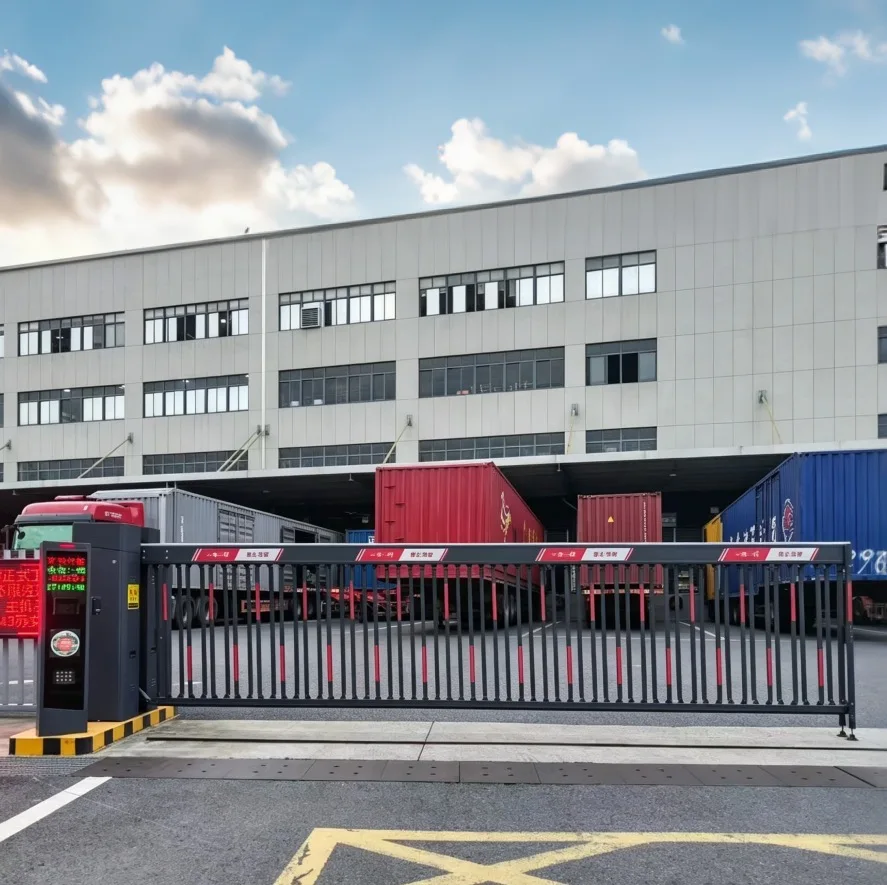
Choosing a heavy-duty parking barrier is not just about buying a bigger boom gate. The motor, boom arm, operating cycle, safety system and access-control technology all have to match the actual volume and type of vehicles passing through the entrance. For warehouses, industrial parks, malls, office buildings, toll-related facilities and gated communities in the Philippines, it pays to choose a barrier that can run reliably in daily operation.
Quick answer: Choose a heavy-duty parking barrier by matching duty cycle, motor, boom arm, safety features and access control to your actual traffic and site conditions, not by price or opening speed alone. Always confirm model-specific ratings on the current datasheet and in a written quotation.
The BAROXON Philippines site features heavy-duty automatic barrier gates for residential and industrial access, high-performance outdoor barriers, and systems that can be paired with LPR/ANPR or RFID/UHF access control. In this guide, we discuss the key criteria to review before buying so your project team can select the right configuration instead of relying on price or opening speed alone.
1. Determine Traffic Volume and Duty Cycle
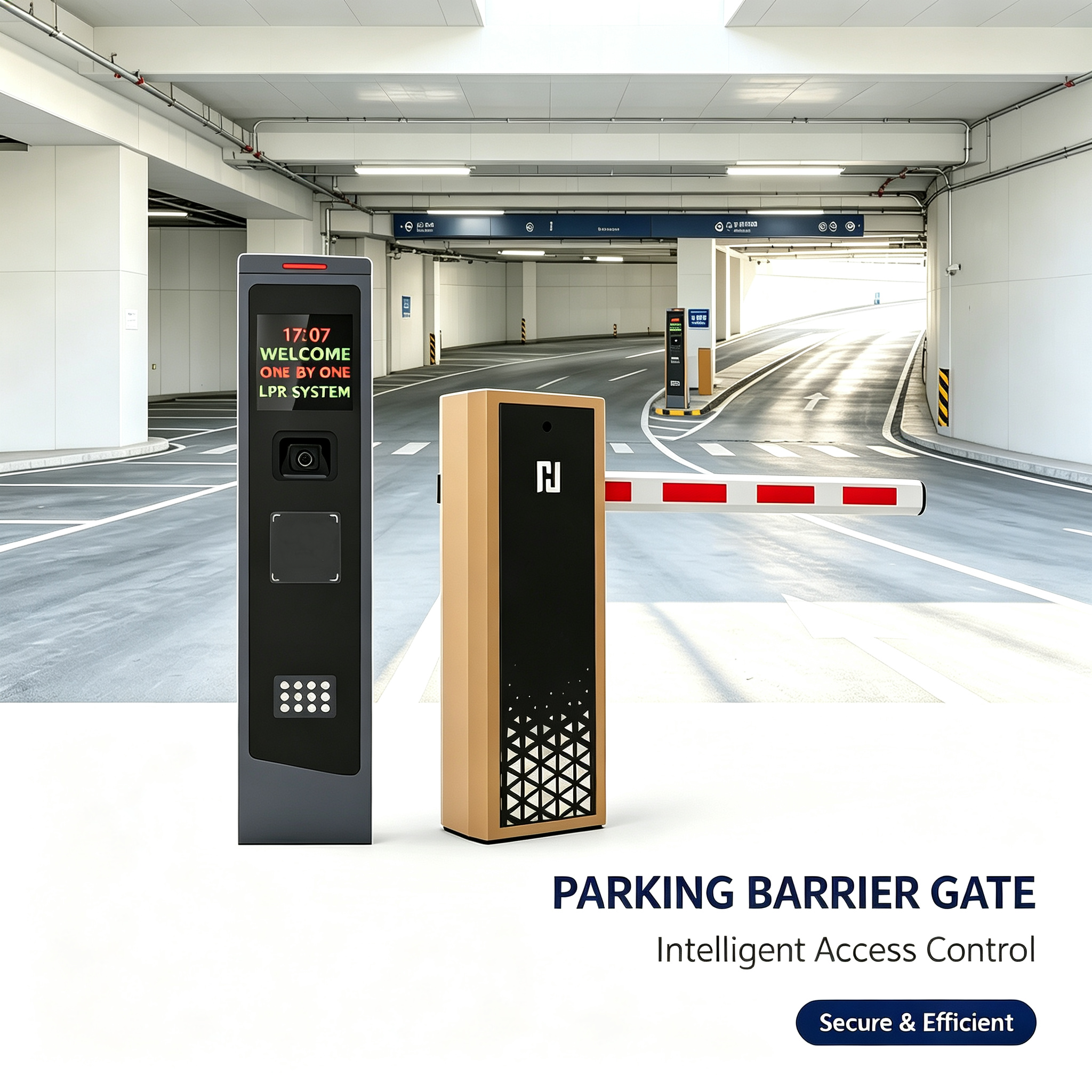
The first question is: how many vehicles pass through the lane per hour and per day? A small office car park, a condominium entrance, a distribution warehouse and an industrial checkpoint all have different requirements. If trucks, delivery vans, employee vehicles and visitors arrive continuously, the operator must be designed for high operating frequency.
Check the duty cycle, or the permitted operating frequency, of the specific model. The BAROXON YH-PDPY601 Heavy Duty Automatic Parking Barrier page states a 100% continuous duty rating and 5,000 cycles per day for heavy-duty use. It also lists various opening and closing speed options and lifecycle figures in the same product specification. Treat these as model-specific published specifications; still request the current datasheet and written confirmation for your project.
Do not choose the fastest barrier without reviewing the whole lane operation. A faster opening does not automatically mean faster overall throughput. Also consider plate recognition time, RFID reading distance, vehicle positioning, safety detection, payment validation and the gap between vehicles.
2. Choose the Right Motor and Drive System
The motor is one of the most important parts of an automatic boom barrier. For high-frequency entrances, check whether the model uses a brushless DC motor, a servo option or another drive configuration, and confirm which power input the site requires. BAROXON YH-PDPY601 product information lists Brushless DC 24V, AC 220V and a servo motor option; the exact supply and configuration must be confirmed for the order.
Ask the supplier about motor protection, the control board, heat management, the manual release procedure and replacement parts availability. At busy sites, barrier downtime can cause queues, delivery delays and extra work for security personnel. A clear maintenance procedure and access to technical support are better planned in advance.
3. Match the Boom Arm to Lane Width and Layout
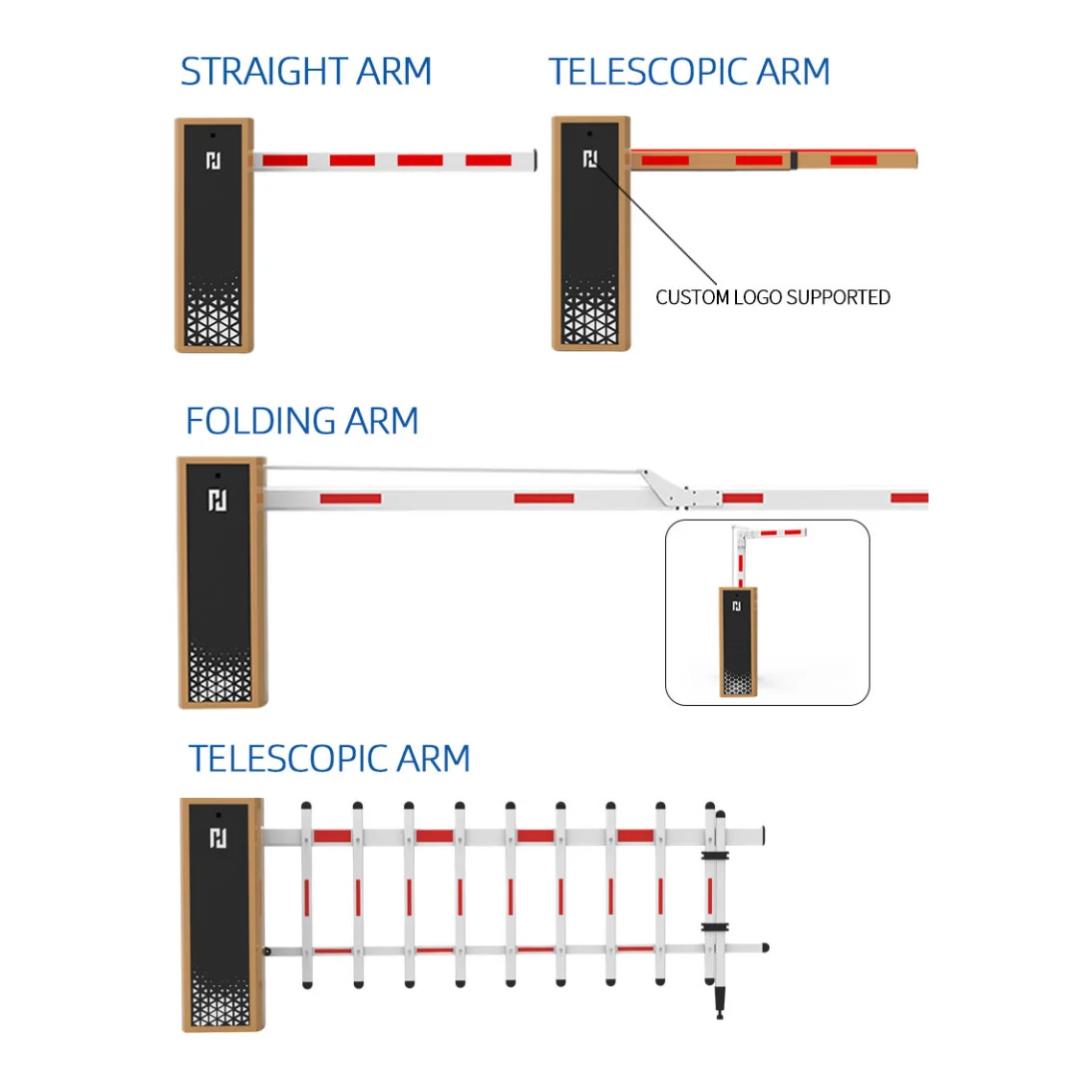
A boom arm is not the same for every entrance. Measure the clear lane width, cabinet location, vehicle turning radius, ceiling height for covered parking, and any obstacle to the arm's upward travel. According to the YH-PDPY601 product specification, straight, folding and fence-type arms are available, with a customizable boom length range of 1 m to 6 m. Confirm the maximum length and compatible arm for the configuration you select.
- Straight arm: Usually suitable for open, straight lanes with sufficient overhead clearance.
- Folding arm: Consider for basements, covered parking or areas with limited vertical clearance.
- Fence arm: Can be used where a clearer physical lane barrier or a wider visual deterrent is needed; ensure proper support and safety layout.
4. Review the Cabinet, Materials and Mechanical Construction
For outdoor and industrial installations, look at the cabinet material, coating quality, internal structure, fasteners and protection against dust and water. The BAROXON YH-PDPY601 listing mentions a cold-rolled steel chassis, stainless steel trims and a zinc alloy internal structure. An IP55 rating is listed for the YH-0DZ1920PRO configuration on a separate product page. Do not assume every model shares the same IP rating; ask for the exact rating of the unit you are buying.
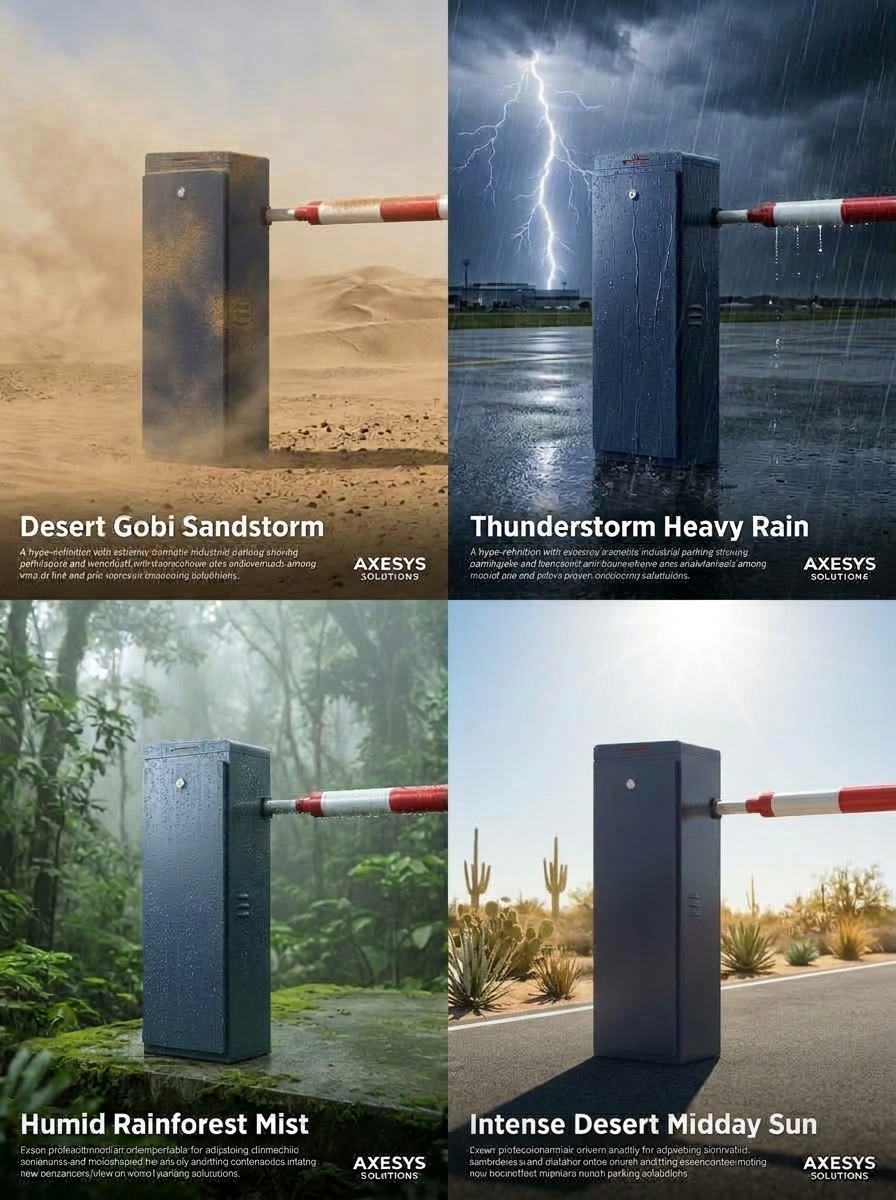
In the Philippines, it is important to consider heavy rain, dust, heat, humidity and possible coastal exposure. Check whether the installation spot is exposed to rain or direct sunlight, whether there is drainage and a canopy, and whether an additional enclosure or corrosion-protection measures are needed. A weather-resistant claim is no substitute for proper site preparation and regular inspection.
5. Prioritize Safety Features and Vehicle Protection
A heavy-duty barrier must not only be sturdy but also safe to use. Find out how it detects a vehicle or obstruction under the boom arm. Depending on the system configuration, this may involve a vehicle loop detector, photocell, radar sensor, anti-collision logic, auto-reverse function or another safety interface. On the BAROXON Philippines site, some product pages describe anti-collision protection and obstruction-related safety features; confirm which of these are included in the exact quotation.
Do not rely on the boom arm alone as a safety device. Loop position, sensor coverage, warning lights, audible alerts, pedestrian separation and traffic signs all need to be planned. Separate the pedestrian path from the vehicle lane wherever possible. The final safety design should comply with local building, electrical and occupational-safety requirements and be reviewed by a qualified installer.
6. Choose the Access Control That Fits Your Operation
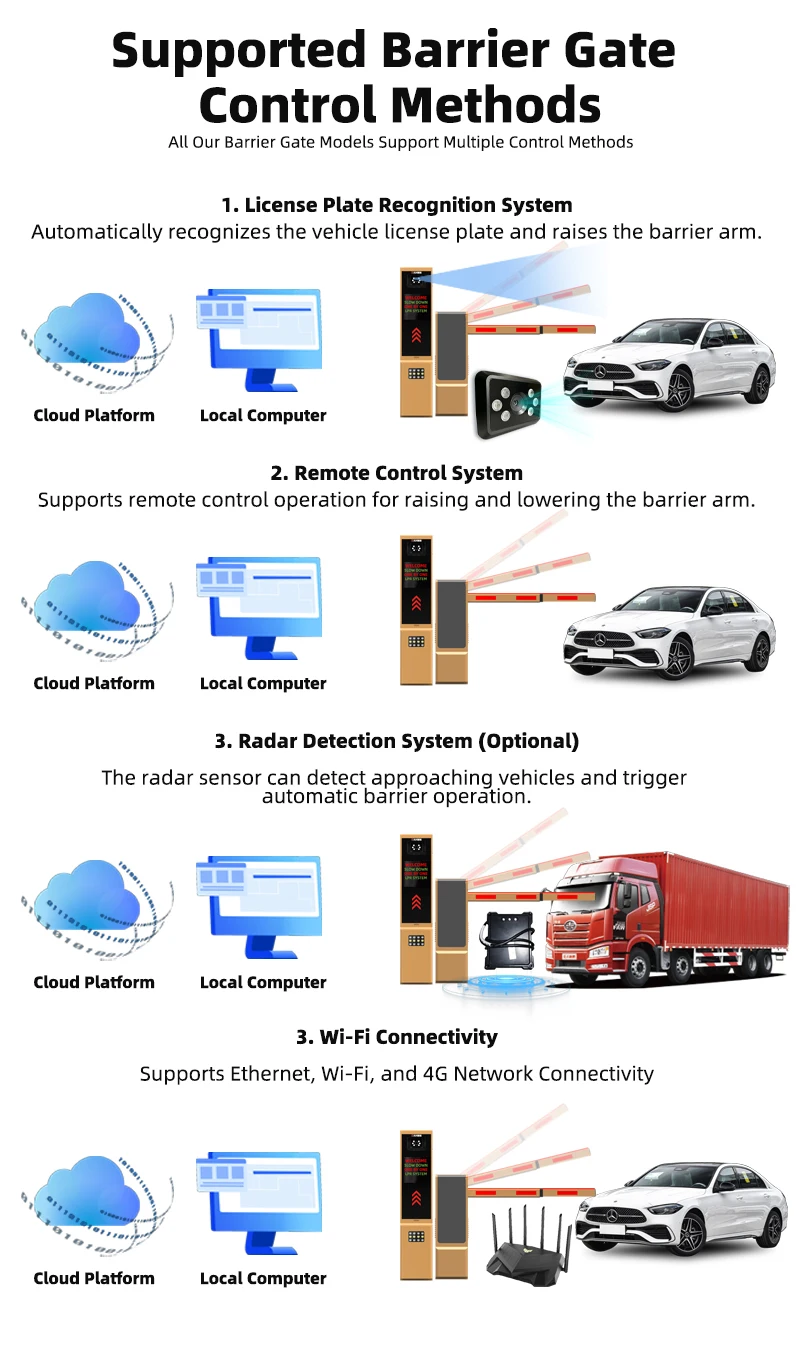
A heavy-duty parking barrier works better when the access-control method matches the site's users and processes. A property may need an RFID card for regular employees, a UHF tag for vehicles that should not stop for long, LPR/ANPR for plate-based identification, or a PIN or remote control for authorized staff. BAROXON product pages list RFID, UHF, LPR/ANPR and other access options, but not all of them are standard on every barrier.
Before buying, ask whether the barrier controller is compatible with your existing parking software, access-control panel, payment system, intercom, network and monitoring platform. Clarify where access logs are stored, whether in local memory, on an SD card or in the cloud, and how records are backed up and retrieved. This matters for audits, visitor management and incident resolution.
7. Consider the Power Supply and Site Conditions
Have the installer assess the actual electrical supply, grounding, cable route, surge protection and backup-power requirement. At sites with power interruptions, discuss whether a UPS or another backup arrangement is needed and what the barrier's safe state will be during a power failure. Do not assume every model has battery backup; this should be clear in the quotation and wiring diagram.
Include the foundation, anchor bolts, drainage, vehicle approach angle, driver visibility and security booth location in the site survey as well. A sturdy operator cannot deliver reliable service if the base is weak, the alignment is wrong or the cable protection is inadequate.
8. Confirm Maintenance, Spare Parts and After-Sales Support
Before issuing a purchase order, ask for the maintenance schedule, recommended inspection intervals, a list of consumable parts and the warranty claim process. Ask about remote diagnostics, installation guides, wiring documentation, video support and spare parts availability. The BAROXON site describes after-sales support such as remote diagnostics, spare parts and technical assistance; clarify the actual coverage, response time and delivery arrangement for your location in the Philippines.
It is a good idea to set a preventive maintenance plan covering boom arm balance, the spring mechanism, fasteners, cabinet condition, sensor alignment, control board terminals and manual release. Inspection frequency should be adjusted to the site's traffic volume and environment, not applied uniformly to every site.
9. Compare Total Cost of Ownership, Not Just the Initial Price
When comparing suppliers, include the barrier operator, boom arm, controller, safety sensors, access readers, installation, civil works, cabling, software integration, shipping, spare parts and maintenance in the costing. A cheaper initial quotation can become more expensive over time if the required safety devices are excluded or if replacement parts are hard to obtain.
Request an itemized quotation and a written technical compliance sheet. It should state the model number, arm type and length, motor configuration, duty-cycle rating, operating speed, protection rating, included safety devices, access-control interfaces, warranty and delivery terms. Compare the same scope before deciding.
Which BAROXON Heavy-Duty Barrier Should You Review?
For industrial and high-traffic applications, you can start the technical evaluation with the BAROXON YH-PDPY601 Heavy Duty Automatic Parking Barrier. The product page describes continuous-duty operation, various arm configurations and adjustable operating speed. For outdoor commercial or industrial entrances, also look at the High-Performance Outdoor Security Parking Barrier Gate. If anti-collision protection is a priority, review the Industrial Security Boom Gate with Anti-Collision Protection. The final choice should be based on lane dimensions, traffic count, environment and required integrations.
Questions to Ask the Supplier Before Buying
- What is the exact model number and current datasheet of the unit?
- What is the rated duty cycle and recommended daily operating volume?
- Which motor and power-supply configuration is included?
- Which boom arm type and maximum length are compatible?
- Which safety sensors and anti-collision functions are included in the quotation?
- What is the ingress-protection rating of the exact model?
- Is it compatible with RFID, UHF, LPR/ANPR or the existing parking software?
- What are the warranty terms, spare-parts lead time and after-sales support for the Philippines?
FAQ: Heavy-Duty Parking Barriers in the Philippines
What does heavy-duty parking barrier mean?
A heavy-duty parking barrier is an automatic vehicle barrier designed for a more demanding operating environment or a higher traffic frequency than an ordinary low-volume entrance. Review the duty-cycle rating, motor, boom-arm compatibility, safety system and maintenance support of the actual model.
How many cycles per day are needed for an industrial entrance?
It depends on the number of vehicles, number of lanes, operating hours and peak-hour traffic. Prepare a traffic estimate and add a reasonable operating margin. Do not choose based only on the highest advertised figure; confirm the rating and warranty conditions in the datasheet.
Is a straight arm, folding arm or fence arm better?
A straight arm is usually suitable for open lanes; a folding arm may be more practical where clearance is low; and a fence arm can be used where a larger visual or physical lane barrier is needed. Verify site dimensions, arm length and safety requirements before ordering.
Can a heavy-duty boom barrier be connected to LPR or RFID?
Yes, an integrated access-control solution can be built with LPR/ANPR, RFID or UHF, provided the selected controller supports it and the reader, software and communication interface are compatible. Confirm the interface and included components with the supplier.
Is a heavy-duty barrier suitable for outdoor installation in the Philippines?
An outdoor-rated configuration may be suitable, but the IP rating and environmental limits of the exact model must be confirmed. Also consider rain, humidity, heat, dust, drainage, corrosion exposure and installation quality.
What maintenance does an automatic parking barrier need?
Regular inspection covers boom-arm balance, the spring and drive mechanism, bolts, the cabinet, wiring, sensor alignment, the control board and manual release. Adjust the schedule to traffic and environment, and follow the manufacturer's maintenance instructions.
Conclusion: Choose the Barrier Based on the Site's Real Requirements
The right heavy-duty parking barrier should match the traffic volume, duty cycle, lane width, boom-arm design, motor configuration, safety requirements and access-control system. For industrial facilities, warehouses, malls, office complexes and residential developments in the Philippines, it is important to review the whole system and its long-term support, not just the barrier's speed or price.
Call to action: BAROXON provides boom barriers and parking access-control options for commercial, residential and industrial applications. Share your lane width, estimated vehicles per day, operating hours, preferred access method and site conditions so we can identify the right model and configuration for your project.
Latest News
Baroxon® | Leading Boom Barrier Manufacturer
Advanced Security Access Control and Intelligent Parking Solutions.
Company Strength
Adequate Inventory
Fast Shipping
Our Products
CONTACT US
Address: No. 2 Wanshou Road, International Innovation Industrial Park, Jinan, Shandong, China


© COPYRIGHT 2025 Baroxon® | Leading Boom Barrier Manufacturer

Contact Us
Professional Manufacturer of Vehicle Barriers & License Plate Recognition Cameras,Smart Parking Access Control Solutions for Global Clients,Reliable Barrier Gates + LPR Systems, Customized to Your Project,From residential communities, commercial shopping malls, industrial parks to highway toll stations, our matched barrier & LPR sets can realize automatic license plate identification, automatic gate lifting, real-time access records, automatic charging and remote management.